公告

峰越教育-专业的美国留学指导机构,汇聚中外方专业顾问,美国顶尖名校前招生官一对一指导,定制适合学员的申请策略。咨询电话:+021-64400795

×

升学资讯

当前位置: 主页 > 升学资讯 >

2022哈佛最佳申请文书出炉!附12条完美文书写作策略!

发布时间:2022-08-20 17:39

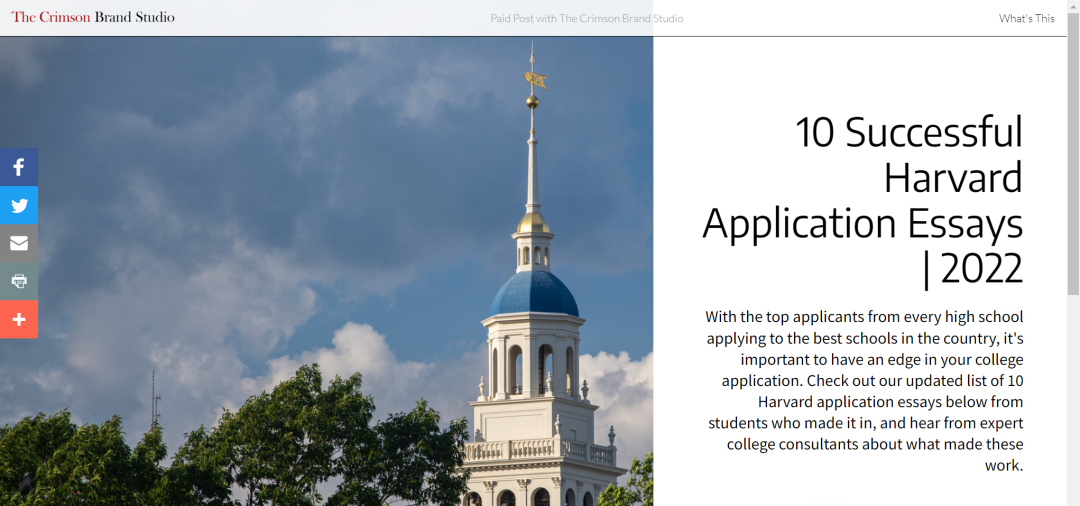
common App和UC系统的开放后,申请季的同学们陆续进入文书准备阶段,哈佛校报也公布了2022年最新录取哈佛的十篇优秀文书,值得提醒大家的是文书头脑风暴前了解清楚每个学校的招生偏好,明白招生官希望从文书中了解哪些申请人的信息才是文书准备正确的打开方式。

下面一起来看下能在哈佛大学脱颖而出的文书。
图片

(实际公布文书9篇)

Successful Harvard Essay

Michelle G.'s Essay

Red, orange, purple, gold...I was caught in a riot of shifting colors. I pranced up and down the hill, my palms extended to the moving collage of butterflies that surrounded me. “Would you like to learn how to catch one?” Grandfather asked, holding out a glass jar. “Yes!” I cheered, his huge calloused fingers closing my chubby five-year-old hands around it carefully.

Grandfather put his finger to his lips, and I obliged as I watched him deftly maneuver his net. He caught one marvelous butterfly perched on a flower, and I clutched the open jar in anticipation as he slid the butterfly inside. It quivered and fell to the bottom of the jar, and I gasped. It struggled until its wings, ablaze in a glory of orange and red, quivered to a stop. I watched, wide-eyed, as it stopped moving. “Grandpa! What’s happening?”

They were not meant to live forever: their purpose was to flame brilliantly and then fade away. Thus, his art serves as a memory of their beauty, an acknowledgement of nature's ephemeral splendor.

My grandfather had always had a collection of butterflies, but that was the first time I saw him catch one. After witnessing the first butterfly die, I begged him to keep them alive; I even secretly let some of them go. Therefore, to compromise, he began carrying a special jar for the days I accompanied him on his outings, a jar to keep the living butterflies. But the creatures we caught always weakened and died after a few days in captivity, no matter how tenderly I fed and cared for them. Grandfather took me aside and explained that the lifespan of an adult butterfly was very short. They were not meant to live forever: their purpose was to flame brilliantly and then fade away. Thus, his art serves as a memory of their beauty, an acknowledgement of nature’s ephemeral splendor.

But nothing could stay the same. I moved to America and as the weekly excursions to the mountainside ended, so did our lessons in nature and science. Although six thousand miles away, I would never forget how my grandpa’s wrinkles creased when he smiled or how he always smelled like mountain flowers.

As I grew older and slowly understood how Grandfather lived his life, I began to follow in his footsteps. He protected nature’s beauty from decay with his art, and in the same way, I tried to protect my relationships, my artwork, and my memories. I surrounded myself with the journals we wrote together, but this time I recorded my own accomplishments, hoping to one day show him what I had done. I recorded everything, from the first time I spent a week away from home to the time I received a gold medal at the top of the podium at the California Tae Kwon Do Competition. I filled my new home in America with the photographs from my childhood and began to create art of my own. Instead of catching butterflies like my grandpa, I began experimenting with butterfly wing art as my way of preserving nature’s beauty. Soon my home in America became a replica of my home in China, filled from wall to wall with pictures and memories.

Nine long years passed before I was reunited with him. The robust man who once chased me up the hillside had developed arthritis, and his thick black hair had turned white. The grandfather I saw now was not the one I knew; we had no hobby and no history in common, and he became another adult, distant and unapproachable. With this, I forgot all about the journals and photos that I had kept and wanted to share with him.

After weeks of avoidance, I gathered my courage and sat with him once again. This time, I carried a large, leather-bound book with me. “Grandfather,” I began, and held out the first of my many journals. These were my early days in America, chronicled through pictures, art, and neatly-printed English. On the last page was a photograph of me and my grandfather, a net in his hand and a jar in mine. As I saw our faces, shining with proud smiles, I began to remember our days on the mountainside, catching butterflies and halting nature’s eventual decay.

My grandfather has weakened over the years, but he is still the wise man who raised me and taught me the value of capturing the beauty of life. Although he has grown old, I have grown up. His legs are weak, but his hands are still as gentle as ever. Therefore, this time, it will be different. This time, I will no longer recollect memories, but create new ones.


专家点评

这篇文章对作者与祖父的童年经历进行了富有诗意的回忆。它描绘了一幅美丽的画面,展示了她从短暂的从美与艺术中汲取了宝贵的人生教训,同时也将作者描绘成一位敏锐的自然与人性观察者。

写一篇关于影响你的人的文章的一个具有挑战性的问题是确保你在描述那个人和仍然保持文章的焦点在你和你自己的发展之间取得适当的平衡。在这种情况下,Michelle设法抓住了她祖父世俗的本质,理解蝴蝶转瞬即逝的本性,同时也富有同情心,理解Michelle对蝴蝶的关心。

同时,这篇文章继续关注Michelle多年来的成长。从祖父那里,她继承了对自然的热爱以及对生活的感悟和反省。我们也看到了她的艺术一面,她将她的蝴蝶翅膀艺术描述为一种保护自然之美的方式。

这篇文章中一个特别令人心酸的部分是,当她九年后终于见到祖父时,她意识到祖父发生了怎样的变化。这篇文章在她祖父的衰老和早期关于他们过去捕捉的蝴蝶的短暂性的经验教训之间做出了一个美丽的类比。它让她想起了生命是多么的短暂,它有力地确立了她关于创造自己的新记忆的最终认识,这是她祖父试图传授给她的主要课程。

总的来说,尽管这篇文章关注的是Michelle的祖父以及他对她的影响,但我们仍然对Michelle有很多了解。我们知道她很有成就(跆拳道金牌)、艺术和爱心。她的深思熟虑和内省的天性在这篇文章中也大放异彩,这无疑是吸引招生委员会的品质。

Homeless for Thirteen Years

Eda's Essay

I sat on my parents’ bed weeping with my head resting on my knees. “Why did you have to do that to me? Why did you have to show me the house and then take it away from me?” Hopelessly, I found myself praying to God realizing it was my last resort.

For years, my family and I found ourselves moving from country to country in hopes of a better future. Factors, such as war and lack of academic opportunities, led my parents to pack their bags and embark on a new journey for our family around the world. Our arduous journey first began in Kuçovë, Albania, then Athens, Greece, and then eventually, Boston, Massachusetts. Throughout those years, although my family always had a roof over our heads, I never had a place I could call “home.”

That night that I prayed to God, my mind raced back to the night I was clicking the delete button on my e-mails, but suddenly stopped when I came upon a listing of the house. It was September 22, 2007 —eight years exactly to the day that my family and I had moved to the United States. Instantly, I knew that it was fate that was bringing this house to me. I remembered visiting that yellow house the next day with my parents and falling in love with it. However, I also remembered the heartbreaking phone call I received later on that week saying that the owners had chosen another family’s offer.

A week after I had prayed to God, I had given up any hopes of my family buying the house. One day after school, I unlocked the door to our one-bedroom apartment and walked over to the telephone only to see it flashing a red light. I clicked PLAY and unexpectedly heard the voice of our real estate agent. “Eda!” she said joyfully. “The deal fell through with the other family—the house is yours! Call me back immediately to get started on the papers.” For a moment, I stood agape and kept replaying the words in my head. Was this really happening to me? Was my dream of owning a home finally coming true?

Over the month of November, I spent my days going to school and immediately rushing home to make phone calls. Although my parents were not fluent enough in English to communicate with the bank and real estate agent, I knew that I was not going to allow this obstacle to hinder my dream of helping to purchase a home for my family. Thus, unlike a typical thirteen-year-old girl’s conversations, my phone calls did not involve the mention of makeup, shoes, or boys. Instead, my conversations were composed of terms, such as “fixed-rate mortgages,” “preapprovals,” and “down payments.” Nevertheless, I was determined to help purchase this home after thirteen years of feeling embarrassed from living in a one-bedroom apartment. No longer was I going to experience feelings of humiliation from not being able to host sleepovers with my friends or from not being able to gossip with girls in school about who had the prettiest room color.

I had been homeless for the first thirteen years of my life. Although I will never be able to fully repay my parents for all of their sacrifices, the least I could do was to help find them a home that they could call their own—and that year, I did. To me, a home means more than the general conception of “four walls and a roof.” A home is a place filled with memories and laughter from my family. No matter where my future may lead me, I know that if at times I feel alone, I will always have a yellow home with my family inside waiting for me.


专家点评

诚实的、令人心碎、强大的。

这是阅读 Eda 的文章后首先想到的三个词。

我们喜欢 Eda 的文章的地方在于它令人耳目一新的脆弱性。太多的申请文书“太”完美了。Eda 不会审查真相,即使承认她的内心想法可能会给她带来负面的印象。例如,她以她在父母床上哭泣的场景开始整篇文章,并将自己的不幸归咎于他们。通过如此诚实的描述,Eda 展示了她随着时间的推移而真正地成长和成熟。

在整篇文章中,她的个人声音也很强烈。当她谈到爱上“那栋黄色的房子”时,我们脑海中会自动浮现出这栋房子的形象。当她谈到得知“那栋黄色房子”被卖给另一个家庭时所经历的心碎时,我们也感到心痛。她故意选择“播放”她为我们收到的语音邮件并包括她随后的内心想法,这进一步促使我们与她一起重温她的旅程。

然而,她不仅仅是告诉我们她的旅程。她强调了她的旅程是多么不寻常。她没有享受关于化妆品或鞋子的电话交谈,而是与经纪人谈论固定利率抵押贷款和首付……所有这些都是在 13 岁时。虽然她没有明确说明这一点(她不需要这样做):很明显Eda 不得不快速成长,成为一个更强大的人。

她对“家”这个词的理解从她头顶的物理屋顶演变为更抽象的屋顶。家就是她的“回忆和欢笑”所在的地方。最后,她接受了父母做出的牺牲。学会为自己的成长感到自豪展示了 Eda 的成长历程。

Eda 是一个能够克服任何挑战的人,使她成为一名强大的大学申请者。

Playing it Dangerous

Lisa's Essay

In hazy stillness, a sudden flurry of colored skirts, whispers of “Merde!” Sternly, my fingers smooth back my hair, although they know no loose strands will be found. My skin absorbs heat from stage lights above—if only that heat would seep into my brain, denature some proteins, and deactivate the neurons stressing me out. A warm hand, accompanied by an even warmer smile, interrupts my frenzied solitude. I glance up. My lovely teacher nods, coaxing my frozen lips into a thawed smile. A complex figure, filled in with doubt, yet finished with shades of confidence: My body takes its place and waits.

One, two, three, four; two, two, three, four. On stage, the lights and music wash over me. Never having had a true ballet solo before, my lungs are one breath away from hyperventilating. Trying to achieve a Zen-like state, I imagine a field of daisies, yet my palms continue sweating disobediently. It’s not that I’ve never been on stage alone before; I’ve had plenty of piano recitals and competitions. Yet, while both performances consume my mind and soul, ballet demands complete commitment of my body.

Gently slide into arabesque and lean downward; try not to fall flat on face—Mom’s videotaping. In terms of mentality, I would hardly be described as an introvert; yet, a fear of failure has still kept me from taking risks. Maybe I was scared of leaping too high, falling too far, and hitting the hard floor. As I moved up in the cutthroat world of dance, this fear only increased; the pressure of greater expectations and the specter of greater embarrassment had held me contained. Now, every single eyeball is on me.

Lean extra in this pirouette; it’s more aesthetic. But is it always better to be safe than sorry? Glancing toward the wings, I see my teacher’s wild gesticulations: Stretch your arms out, she seems to mime, More! A genuine smile replaces one of forced enthusiasm; alone on the stage, this is my chance to shine. I breathe in the movements, forget each individual step. More than just imagining, but finally experiencing the jubilation of the music, I allow my splits to stretch across the stage and my steps to extend longer and longer, until I’m no longer safe and my heart is racing. Exhilarated and scared in the best way, I throw myself into my jumps. I no longer need to imagine scenes to get in the mood; the emotions are twirling and leaping within me.

Reaching, stretching, grabbing, flinging ... My fear no longer shields me. I find my old passion for ballet, and remember the grace and poise that can nevertheless convey every color of emotion. Playing it safe will leave me part of the backdrop; only by taking risks can I step into the limelight. Maybe I’ll fall, but the rush is worth it. I’ll captain an all-male science bowl team, run a marathon, audition for a musical, and embrace the physical and intellectual elation of taking risks.


专家点评

Lisa通过她富有创意的描述性文字成功地激发了读者的真实情感,从而创作了一篇获奖论文,传达了生动的意象、发自内心的感受和有益的内省。

我立刻把Lisa的寓言比作一只被关在封闭的笼子里的鸟,笼子象征着我们在生活中所面对的一切,我们的恐惧。Lisa的第一次芭蕾舞独奏精彩地表现为她的“啊哈!在那一刻,她抛开恐惧(打开笼子),并通过认真的自我反省,选择拥抱未来的风险(勇往直前)。

在第1-3段中,Lisa通过她美丽、丰富的语言和形象的描述瞬间吸引了我们,她将自己描绘成因压力、对失败和家庭/公众舆论的恐惧而动弹不得。我感同身受,想了解更多!她那温暖的幽默闪耀着完美的光芒:她想去激活她的大脑神经元,并提醒自己不要摔倒,以免被她的母亲/家人责骂 - 做得很好!Lisa用她的“可爱的老师”作为她的基础、舒适区和支持者,这是许多人可以分享的主题。她的焦虑是相对的,她用这一点来解释她厌恶风险的本性(转自完美留学)。

在第 4-5 段中,Lisa的独奏被生动地描述为她跳舞并实现转变的决定性时刻——恐惧变成了激情和兴奋。她在瞬间充满诗意,微笑,摆脱恐惧,像一杯温暖的牛奶一样拥抱风险。人们提出了一个尖锐的问题,“但安全总比后悔好吗?” 通过反省,Lisa表达了她追求风险的愿望,风险将使她个人进步。承认她可能并不总是成功,“匆忙是值得的”。Lisa最后列举了她将在学校里追求的领导角色和活动的具体例子——招生官员对那些渴望走出自己的舒适区,并在校园里开始新的冒险/挑战的学生表示赞同。

为了让这篇文章更强大,这篇文章以独特的叙事形式写得非常出色,营造了一种充满活力、有趣、深刻和相关的体验。Lisa的个人品质贯穿整篇文章:创造力、决心、克服障碍、自我反省、在风险中成长,当然还有激情!我们在动力方面留下了光辉的一课,希望摆脱这种负面情绪,继续前进并取得更大的成就——“playing it dangerous”。

Successful Harvard Essay

Yueming's Essay

My Ye-Ye always wears a red baseball cap. I think he likes the vivid color—bright and sanguine, like himself. When Ye-Ye came from China to visit us seven years ago, he brought his red cap with him and every night for six months, it sat on the stairway railing post of my house, waiting to be loyally placed back on Ye-Ye’s head the next morning. He wore the cap everywhere: around the house, where he performed magic tricks with it to make my little brother laugh; to the corner store, where he bought me popsicles before using his hat to wipe the beads of summer sweat off my neck. Today whenever I see a red hat, I think of my Ye-Ye and his baseball cap, and I smile.

Ye-Ye is the Mandarin word for “grandfather.” My Ye-Ye is a simple, ordinary person—not rich, not “successful”—but he is my greatest source of inspiration and I idolize him. Of all the people I know, Ye-Ye has encountered the most hardship and of all the people I know, Ye-Ye is the most joyful. That these two aspects can coexist in one individual is, in my mind, truly remarkable.

Ye-Ye was an orphan. Both his parents died before he was six years old, leaving him and his older brother with no home and no family. When other children gathered to read around stoves at school, Ye-Ye and his brother walked in the bitter cold along railroad tracks, looking for used coal to sell. When other children ran home to loving parents, Ye-Ye and his brother walked along the streets looking for somewhere to sleep. Eight years later, Ye-Ye walked alone—his brother was dead.

Ye-Ye managed to survive, and in the meanwhile taught himself to read, write, and do arithmetic. Life was a blessing, he told those around him with a smile.

Years later, Ye-Ye’s job sent him to the Gobi Desert, where he and his fellow workers labored for twelve hours a day. The desert wind was merciless; it would snatch their tent in the middle of the night and leave them without supply the next morning. Every year, harsh weather took the lives of some fellow workers.

After eight years, Ye-Ye was transferred back to the city where his wife lay sick in bed. At the end of a twelve-hour workday, Ye-Ye took care of his sick wife and three young children. He sat with the children and told them about the wide, starry desert sky and mysterious desert lives. Life was a blessing, he told them with a smile.

But life was not easy; there was barely enough money to keep the family from starving. Yet, my dad and his sisters loved going with Ye-Ye to the market. He would buy them little luxuries that their mother would never indulge them in: a small bag of sunflower seeds for two cents, a candy each for three cents. Luxuries as they were, Ye-Ye bought them without hesitation. Anything that could put a smile on the children’s faces and a skip in their steps was priceless.

Ye-Ye still goes to the market today. At the age of seventy-eight, he bikes several kilometers each week to buy bags of fresh fruits and vegetables, and then bikes home to share them with his neighbors. He keeps a small patch of strawberries and an apricot tree. When the fruit is ripe, he opens his gate and invites all the children in to pick and eat. He is Ye-Ye to every child in the neighborhood.

I had always thought that I was sensible and self-aware. But nothing has made me stare as hard in the mirror as I did after learning about the cruel past that Ye-Ye had suffered and the cheerful attitude he had kept throughout those years. I thought back to all the times when I had gotten upset. My mom forgot to pick me up from the bus station. My computer crashed the day before an assignment was due. They seemed so trivial and childish, and I felt deeply ashamed of myself.

Now, whenever I encounter an obstacle that seems overwhelming, I think of Ye-Ye; I see him in his red baseball cap, smiling at me. Like a splash of cool water, his smile rouses me from grief, and reminds me how trivial my worries are and how generous life has been. Today I keep a red baseball cap at the railing post at home where Ye-Ye used to put his every night. Whenever I see the cap, I think of my Ye-Ye, smiling in his red baseball cap, and I smile. Yes, Ye-Ye. Life is a blessing.


专家点评

(据说这一篇华裔申请者的文书,大家可以感受一下)

Yueming的文书是一篇完美的申请文书,它完全符合它的要求:即展示了Yueming的形象,并允许招生委员会了解他的其他申请材料中没有包含的关于他的事情。Yueming用他的爷爷棒球帽的故事向读者展示了对他来说什么是重要的,并展示了他将为校园生活做出贡献的关键人格特征(转自完美留学)。

尽管大部分文本都是专门讲述爷爷的传记,但这篇文章不仅仅是关于他的。爷爷的整个故事是最后几段的前奏,揭示了Yueming性格中最重要的方面。就像在生活中一样,我们祖先的过去是后代历史的前奏,而后代的历史还在不断涌现。这种微妙的平行,乍看之下并不明显,让读者了解Yueming性格的深刻发展和深入了解事物本质的天赋。

Yueming展示了他从他人经验中学习的能力,他强调了自己的韧性和从爷爷那里获得的积极心态。这些品质对于未来的哈佛学生来说无疑是必不可少的,并展示了他在校园内外体现“生活是一种祝福”的能力。

Successful Harvard Essay

Charles' Essay

James was not fitting in with everyone else. During lunch, he sat alone, playing with his own toys. During group activities, the other campers always complained when paired with him. What was wrong? As camp counselor, I quietly observed his behavior—nothing out of the ordinary. I just couldn’t fathom why the other campers treated him like a pariah.

After three days of ostracism, James broke down during a game of soccer. Tears streaming down his cheeks, he slumped off the field, head in his hands. I jogged toward him, my forehead creased with concern. Some campers loudly remarked, “Why is that creep crying?” Furious indignation leaped into my heart. They were the ones who “accidentally” bumped into him and called him “James the Freak.” It was their cruelty that caused his meltdown, and now they were mocking him for it. I sharply told them to keep their thoughts to themselves. I squatted beside James and asked him what was wrong. Grunting, he turned his back to me. I had to stop his tears, and I had to make him feel comfortable. So for the next hour, I talked about everything a seven-year-old boy might find interesting, from sports to Transformers.

“I have a question,” I asked as James began to warm to me. I took a deep breath and dove right into the problem. “Why do the other campers exclude you?” Hesitantly, he took off his shoes and socks, and pointed at his left foot. One, two, three … four. He had four toes. We had gone swimming two days before: All the campers must have noticed. I remembered my childhood, when even the smallest abnormality—a bad haircut, a missing tooth—could cause others, including myself, to shrink away. I finally understood.

But what could I do to help? I scoured my mind for the words to settle his demons. But nothing came to me. Impulsively, I hugged him—a gesture of intimacy we camp leaders were encouraged not to initiate, and an act I later discovered no friend had ever offered James before. Then, I put my hand on his shoulder and looked him straight in the eyes. I assured him that external features didn’t matter, and that as long as he was friendly, people would eventually come around. I listed successful individuals who had not been hindered by their abnormalities. And finally, I told him he would always be my favorite camper, regardless of whether he had two, five, or a hundred toes.

On the last day of camp, I was jubilant—James was starting to fit in. Although the teasing had not completely disappeared, James was speaking up and making friends. And when, as we were saying our good-byes, James gave me one last hug and proclaimed that I was his “bestest friend in the whole wide world,” my heart swelled up. From my campers, I learned that working with children is simply awesome. And from James, I learned that a little love truly goes a long way.


专家点评

Charles(Charles Wong)讲述了看到某人被排除在外的常见经历,并解释了他如何与之抗争。在他作为营地辅导员的个人描述中,Charles不仅表达了他对他人的深切关心,而且还展示了他如何解决一般问题的思维过程。他不只是宣布这些个人特征,而是通过个人材料展示它们。有针对性地决定“展示”而不是“讲述”是一种优秀的写作策略。

首先,Charles从他对情况的描述开始。他的语气随意而直接。他结合了重要的细节,但他的写作并不是多余的。他的文章简洁易懂。虽然这种方法似乎不够成熟,但它反映了查理的原始、真实的想法。读者能感受到他的关心;Charles带领我们度过了他真正的困境。此外,他描述的善举——鼓舞人心的谈话、拥抱——让我们深入了解了他的性格。包含这些细节的决定将Charles描绘成一个善良而聪明的个性,在任何大学校园里都是有价值的。

此外,Charles不仅描述了他如何解决这个特殊问题的,而且将其扩展到日常生活中。他从看似平凡的经历中领悟了意义,并解释了它如何改变了他的整个心态。这种有意识地成长的能力表明Charles有从所有生活中学习的动力,他不仅仅是教室里的学生。

Successful Harvard Essay: Yukta

Yukta's Essay

Garishly lined with a pearlescent lavender, my eyes idly scanned the haphazard desk in front of me, settling on a small kohl. I packed the ebony powder into my waterline with a shaky hand, wincing at the fine specks making their way into my eyes.

The girl in the mirror seemed sharper, older, somehow. At only 12, I was relatively new to the powders and blushes that lined my birthday makeup kit, but I was determined to decipher the deep splashes of color that had for so long been an enigma to me.

After school involved self-inflicted solitary confinement, as I shut myself in my bedroom to hone my skills. The palette’s colors bore in, the breadth of my imagination interwoven into now-brittle brushes. Much to my chagrin, my mom walked in one day, amused at my smudged lipstick, which congealed on the wispy hairs that lined my upper lip.

“Halloween already?” she asked playfully.

I flushed in embarrassment as she got to work, smoothing my skin with a brush and filling the gaps in my squiggly liner. Becoming a makeup aficionado was going to take some help.

“What’s this even made of?” I asked, transfixed by the bright powder she was smattering on my cheeks.

“You know, I’m not sure,” she murmured. “Maybe you should find out.”

I did.

Hours down the internet rabbit hole, I learned that the shimmery powder was made of mica, a mineral commonly used in cosmetics. While the substance was dazzling, its production process was steeped in humanitarian violations and environmental damage. Determined to reconcile my burgeoning love for makeup with my core values, I flung the kit into the corner of my drawer, vowing to find a more sustainable alternative. Yes, I was every bit as dramatic as you imagine it.

Now 17, I approach ethical makeup with assured deliberation. As I glance at my dusty kit, which still sits where I left it, I harken back on the journey it has taken me on. Without the reckoning that it spurred, makeup would still simply be a tool of physical transformation, rather than a catalyst of personal growth.

Now, each swipe of eyeliner is a stroke of my pen across paper as I write a children’s book about conscious consumerism. My flitting fingers programmatically place sparkles, mattes, and tints across my face in the same way that they feverishly move across a keyboard, watching algorithms and graphs integrate into models of supply chain transparency. Makeup has taught me to be unflinching, both in self expression and my expectations for the future. I coat my lips with a bold sheen, preparing them to form words of unequivocal urgency at global conferences and casual discussions. I see my passion take flight, emboldening others to approach their own reckonings, uncomfortable as they may be. I embark on a two-year journey of not buying new clothes in a statement against mass consumption and rally youth into a unified organization. We stand together, picking at the gritty knots of makeup, corporate accountability, and sustainability as they slowly unravel.

I’m not sure why makeup transfixes me. Perhaps it’s because I enjoy seeing my reveries take shape. Yukta, the wannabe Wicked Witch of the West, has lids coated with emerald luster and lips of coal. Yukta, the Indian classical dancer, wields thick eyeliner and bright crimson lipstick that allow her expressions to be amplified across a stage. Deep rooted journeys of triumph and tribulation are plastered across the surface of my skin — this paradox excites me.

Perhaps I am also drawn to makeup because as I peel back the layers, I am still wholly me. I am still the young girl staring wide-eyed at her reflection, earnestly questioning in an attempt to learn more about the world. Most importantly, I still carry an unflagging vigor to coalesce creativity and activism into palpable change, one brushstroke at a time.


专家点评

这位学生使用与化妆品一样常见的家居用品来构建一个既普遍又独特的故事。这对象反映了她个人和文化身份的各个方面,使读者可以直接感受到学生的个性。她通过她对她周围世界的调查,带领我们踏上了一次全面的旅程,并在不忽视文章主题的情况下开始了一个成年故事。该学生在成功的个人陈述不可或缺的叙述和创意写作元素之间取得平衡。作者通过化妆作为自我反省和发现的媒介,让我们瞥见了她多年来的个人发展。她巧妙地利用她的化妆系列的颜色和元素来制作生动的描述,将图像作为本文方法和成功的基石。她提出了一个很容易与消费主义和肤浅联系在一起的目标,并用它来支持她所倡导的社会和道德斗争。

我们也看到这篇文章的作者有一个明确的声音。虽然许多学生都在努力克服通过装饰来提升写作水平,但这位作者却能够运用一种充满活力的写作风格,仍然能引人入胜、有节奏和有条理。通过这篇文章的每一刻,我们了解到作者关心的是什么:有意识的消费主义、创造力和行动主义;我们还了解了她是如何思考的:好奇、无私、带有女权主义色彩。这篇文章的开头句子采用了成功的个人陈述写作策略,丰富的形容词详细描述了一个小场景,然后扩大到对作者和她在社会中的地位做出更大的评论。最后,学生的论文补充了她更大的招生档案,让读者在其中了解了Ta多年的倡导、可持续实践、以及对其社区产生积极影响的意图。

哈佛大学夏校官网近日还发布总结了【12条完美文书写作策略】,从文书主题到写作细节,与以上其中几位招生官的点评不谋而合,对目前正为文书“发愁”的同学颇有指导意义:


1 真诚:讨论的话题一定要对你真的重要,用对你来说最自然的语气和讲述方式,而不是专门为了让招生官印象深刻;


2 开篇抓人:要知道和你一起竞争招生官注意力的申请者成千上万,所以开头段落必须立刻抓住读者的想象力,例如可以用一句直白的陈述、引人深思的名句、一个设问或者描述一个场景等等;


3 主旨深刻:招生官更想知道这些经历如何塑造了你,所以注意将你的故事和自身的成长联系起来;


4 Show Don’t Tell:一篇吸引人的文书不是复述自己的活动列表,而是创造情景,提供鲜活的故事;


5 尝试差异化:给自己的故事找一个新鲜的角度,比如大部分学生会写自己成功的经历,但从失败中汲取教训就是另一个角度;


6 面向读者写作:从读者角度出发,来审视自己的文书是否逻辑清晰,论证有理,信息是否遗漏;


7 多改几稿:写完一版后,几天后重新再看,可以给你新的视角,并发现改进空间;


8 朗读文书:把文字读出声,可以有效发现冗余段落和信息漏误;


9 不要重复:文书是对其他申请材料的补充,你的文书应该告诉招生官一些新的信息;


10 请别人阅读:请老师、朋友、家长等阅读你的文书,他人的视角会给你新的修改建议;


11 注意格式:字数、标点、空行等都是要注意的细节;


12 结尾有力:结尾简介连贯、反映真诚的自省、提供生动的细节并且巧妙表达出自己的观点。

上一篇:美国公立学校如何选?

下一篇:这300多名学生拒绝哈佛offer,背后的原因是?